NaBloPoMo

In previous posts here I’ve written about Haiku writing as a means of gaining control when angry and I’ve written about Morning Pages and free flow writing from prompts. There is also “letter writing”. Often simply the act of writing a letter expressing feelings, then tearing them up, never sending them is more than sufficient for healing.

This morning I was reminded that “Letters to the Editor” of our newspapers is also another access to freely expressing ourselves, powerfully so, when there is a point rather than the act of simply “venting.”

Writing to my local newspaper was something I did quite frequently many years ago when I was involved in my community both in library organization and then when I was teaching art in the public schools in my town. Mostly they were to inform.

The particular letter I thought of today that’s the seed for this post was one I wrote during an election campaign for our local Board of Education, particularly volatile with one candidate who was president of the Board, or became president. I probably still have the letter, written more than 40 years ago.

One of the main phrases that I recall was my statement that “[he – the candidate] was doing nothing but throwing empty phrases to brew a burning cauldron of hostilities.”

During that same time period, I went back to college to get my degree in Fine Arts Education. Painting and Drawing was the first Art course I took. My professor, recently retired, had mostly criticism for whatever I produced. Toward the end of the semester she told me my “work lacked emotion” and I “should drop out of school and join a local guild to satisfy my housewifely ambitions!”

Anger flared and I immediately thought of the above-mentioned letter to the editor. “That was certainly FULL of emotion!” I went home grabbed a masonite board, a newspaper, paints, glue and match sticks and put together an assemblage – painting the fire and the cauldron, filling it with “hate” and other “anger” and “war” words cut from the newspaper, adding the matches to reinforce the fire.
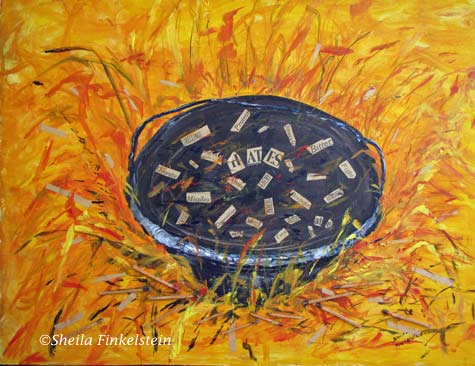
Burning Cauldron of Hostilities

I proceeded to bring it into the next class. I don’t recall what her response to it was. What I did realize years later was that, in fact, this piece did not convey the emotion of the feelings. What I had done was illustrate the seething emotions that had been behind the expressive words in the “letter to the editor”. Also, I still find it interesting that although I am known as a visual artist when it comes to expressing emotions I immediately go to words and writing. (The emotions expressed in my art, mainly my photography, come from a whole different, unidentified, subconscious level. )

Words of Anger and Hate in the Cauldron

Words in the Burning Cauldron of Hostilities

A close-up of the words, headlined in my newspapers in the late 60’s, used in the collage. I find it interesting observing now that the only word I cut up was “hate”, used three times.

In conclusion, several forms of self-expression were covered here. What is and are yours? If anything has opened up for you from my experiences described here, I’d love to read them in the comments here. Thank you.

(Note for those who may be curious about what happened insofar as “dropping out of school”: I did take the next semester off and then went back. I did not think one had to be a good or great artist to be an effective art teacher. Having stopped attending school board meetings, where I might be likely to speak out and ruffle feathers, I did get a job teaching art in the elementary school in my district where I taught for six years.

Thirty years later, an email from a former student attests to my having made the right decision! There were also many letters to the editor and School Board from parents and teachers when my teaching position was eliminated due to decline in enrollment.)

{ 1 comment }

Love is Like Candy Kisses – NaBloPoMo – Day 5

by Sheila Finkelstein on July 24, 2009

Yesterday, I mentioned that my friend and mentor Julie Jordan Scott is Introducing the Summer Writing Intensive Creativity Camp (at Home or wherever you happen to be).  Today I’m going through old notebooks and I am reminded of how much Julie has contributed to my life.  It was in her courses, in free flow responses to simple writing prompts, and subsequent sharings, that I gained confidence in my own voice with a willingness to be public myself.

Since I’ve been writing about “love” directly, or as an underpinning, in most of the posts here thus far, I thought I’d share my response four years ago to Julie’s, “What questions does love ask?” ” What responses do I give to love?”

I wrote:

Love is like candy kisses waiting to be unwrapped – the paper string pulled out, the crinkled foil, the doubts peeled away

The little chocolate kiss, in its love full and tapered shape, eagerly awaits to be tasted.

Sometimes many mindlessly devoured at once, all fulfilling their life purpose.

How much richer is it when each bit of the morsel of love is tasted and ripened?

Love is like an adventure – sometimes delicious, sometimes painful.

{ 5 comments }

Music for Openings Sparks Writing – NaBloPoMo Day 4

by Sheila Finkelstein on July 22, 2009

Earlier this week, I was on an empowering teleclass, “Catch the Breeze – Radical Weight Loss from the Inside out” led by Marcia Breitenbach, The Songletter Lady and Transformation Specialist. The call was about “energy” and “releasing” and during it she spoke of music as access to unlocking areas of our brain, opening up energy blocks . She spoke of how music is being used with people afflicted with Parkinson’s Disease and others with Alzheimers.

I immediately started feeling sad and teary. Then I got absorbed in other segments of the call and was able to let those feelings go. The next day I was once again filled with guilt, sadness and remorse, for I had been aware of the impact of music and in the day-to-day living, where music was not an integral part Sam’s and my life, I had forgotten about it.

What made it “worse” as I remembered, was that a friend had composed an upbeat song which she sang as she played her ukulele.  She gave us a copy of her rough recording. We both enjoyed it, especially Sam, and then as time went on I forgot about it and the power of the music.  Because of the effects of Parkinson’s Disease, Sam was not likely to remember, himself, to generate such conversations and reminders.

Once again, I am faced with “There are no do-overs”.  As I write the “story” of it, I am able to do more releasing. At the same time I am healing and reminding myself of the “good” things I did as a caregiver, the walks we had, the things we enjoyed. I can also remind myself that sharing like this can empower others and I know that Sam, also, would have appreciated that.  People mattered greatly to him also.

During the same teleclass, Marcia suggested we take on being with our challenges as “allies”, rather than enemies. Thus, “Sadness is my ally.” “Grief is my ally.”  “Tears are my ally.”  They are some of the components of my life, my “friends” who encourage me to write and put myself out to share and make a difference with others.

To learn more about Marcia’s work, I invite you to visit her site,  The Magnificent You. You can get the words for and listen to the Magnificent You song at Songletter. This page also includes explanations on “Music Creating New Software in the Brain” and more.

Note: For those interested in doing more exploration in writing for yourself, my friend and mentor Julie Jordan Scott is Introducing the Summer Writing Intensive Creativity Camp (at Home or wherever  you happen to be) See  Summer Writing Camp for details.

{ 3 comments }

Healing as Defined in Online Dictionaries – plus Haiku

by Sheila Finkelstein on July 20, 2009

Yesterday I concluded here with “all writing is healing.” Today in my Morning Pages writing (also referenced yesterday – 7/19), this statement surfaced and the thought to check the dictionary kicked in. It seemed like a good idea, a foundation for this blog, so I did. I found:

1. To restore to health or soundness; cure. See Synonyms at cure.
2. To set right; repair: healed the rift between us.
3. To restore (a person) to spiritual wholeness.

http://www.thefreedictionary.com/healing (See Below for more definitions.)

“Cure”, “return to wholeness”, “restore”, “repair”, all words that are included in the above. All imply something is/was wrong prior to the healing process. And that’s what it is, a “process.”

In November 2005, I wrote: “Haiku When Fatigued”:

Scattered all over
Pieces of my heart shattered
Love’s disappointment

When I write for healing, in my Morning Pages and/or from prompts in my writers’ group, the words simply come. Without a specific set intention, they flow from within. The “Haiku When Fatigued” was written two years before Sam died. The “love’s disappointment” I’m sure was referring to my expectations that our lives would have healthily gone on intertwined forever, or until one of us peacefully passed in his or her sleep at a much older age… in the nineties at least. (Sam was 75 and he was blessed with basically good health during most of those years.)

We never expected anything like Parkinson’s Disease. Fortunately for both of us Sam, gentle, accepting man that he was, was able to be with it throughout his 10+ years of affliction and accept what was happening.

I wasn’t so accepting. Anger would set in and so I wrote and counted syllables to gain control:

My days are stress-filled
Insidious I call it
Parkinson’s Disease

Smart, bright, humor-filled
“Sam’s the Man” they all do say
Gentle, loving, kind.

Tapping into Sam
The part that’s rich and funny
My sweet loving man

Gentle smile face aglow
Humor sparkles in his eyes
Often disappears
©11/05 Sheila Finkelstein

In October of 2008, almost a year after his death, I set up a web page with memories of those smiles and stories he wrote with photos of our sons as toddlers. See SAM SMILES. This was another creative form of healing for me.

So, I’m back to where I started today and leaving with other questions… “Restoring” to what? I like the sound of “spiritual wholeness”. And what would that look like? Also, is it a “restoration” or a new “creation?
________________________

MORE DEFINITIONS of “HEALING”:
Tending to cure; soothing; mollifying; as, the healing art; a healing salve; healing words.
http://www.answers.com/topic/healing-2

heal⋅ing  [hee-ling]
–adjective
1. curing or curative; prescribed or helping to heal.
2. growing sound; getting well; mending.
–noun
3. the act or process of regaining health: a new drug to accelerate healing.
http://dictionary.reference.com/browse/healing

healing,

n 1. the process of recovery, repair, and restoration.
2. return to wholeness.
http://medical-dictionary.thefreedictionary.com/healing

and medically defined from the same site

healing /heal·ing/ (hēl´ing) a process of cure; the restoration of integrity to injured tissue.

healing by first intention that in which union or restoration of continuity occurs directly without intervention of granulations.
healing by second intention union by closure of a wound with granulations.
spiritual healing the use of spiritual practices, such as prayer, for the purpose of effecting a cure of or an improvement in an illness.
healing by third intention treatment of a grossly contaminated wound by delaying closure until after contamination has been markedly reduced and inflammation has subsided.
http://medical-dictionary.thefreedictionary.com/healing

{ 0 comments }

I have been in my head on what I can do here on this blog.

Do I share my writing? Do I invite you to post your healing writing? Do I need photos?
Is this about writing? Is it about healing – how to heal?
Is there such a thing as an answer to “How to heal?” And I could keep going on asking myself, and you, questions and questions.

Do I ever answer them? Sometimes.
Are there always answers? Probably. Not always the ones we want to hear.

On the other hand, if we are open to writing, simply writing – free form , with no intention other than to write whatever comes out, then usually some answers appear, often totally unexpected.

Off and on for years, I have been following Julia Cameron’s recommendation for “Morning Pages”, which I first read about in THE ARTIST’S WAY: A Spiritual Path to Higher Creativity . It’s also one of the core practices covered in each of her subsequent books. For those unfamiliar with them, “Morning Pages” are three pages of free flow writing, longhand, first thing in the morning. I have gone through periods where I have done this faithfully, daily , and I know the practice frees up my day. I will admit there are mornings where e-mail first wins out AND I still manage to go back to my spiral notebook.

One of the “rules” is to not look at the pages for at least two weeks after writing them. I often keep a separate pad beside me to jot down the “to-do’s” that often surface during those 15 or 20 minutes. This morning I started writing in a fresh book and to my dismay I discovered I had inadvertently purchased the “college-ruled” rather than the “wide-ruled” pages. Heck, I may be a “good girl” and do my three pages of writing daily, but I don’t want to write more than I have to, plus those narrow spaces are confining.

Being one who usually finds a way to “bend the rules” and still be “right”, I decided I would simply count the number of lines in the wide ruled books and do perhaps one and a half spaces for each of my lines. Instead of simply counting spaces in each of the books, I realized I could simply go to a book already used up and count the handwritten lines…easier to do also.

Interestingly, the book I picked up from a pile sitting near by was one in which I had written two days after Sam died. A couple of scattered pages throughout that notebook also had some other “healing” writing…writing from prompts in my writing group. I was moved by what I read and reminded that I’ve been thinking about going back to older writings and putting them together.

Then I read about the NaBloPoMo – National Blog Posting Month – Challenge, which is writing every day in one’s blog. I decided to take it on. The 30 day count-down begins the day we start. It will be a great discipline for me and a practice in non-perfection.

I know I often go into long stories, then edit, wonder, “The point is?”, and continue on down the path of “presumed perfectionism”. The intent here will be to simply post daily (could be old writings) and know that from the practice conciseness will come. And, it will be OK if it doesn’t.

The blog in which to take on the challenge is this one. For “all writing is healing.”

{ 1 comment }